
When Can You Cut Hedges in Ireland? The Rules Explained
When Can You Cut Hedges in Ireland? The Rules Explained
Published 5th October, 2026 by Passion Landscaping and Tree Surgeons
Every year, as soon as the weather warms up, the same question comes up: can I cut my hedge yet? It’s a fair thing to ask, because in Ireland the answer isn’t just about when the hedge looks scruffy. There’s a law about it.
Here’s a plain-English guide to what the rules say, who they apply to and when you can get the hedge trimmer out.
The Quick Answer
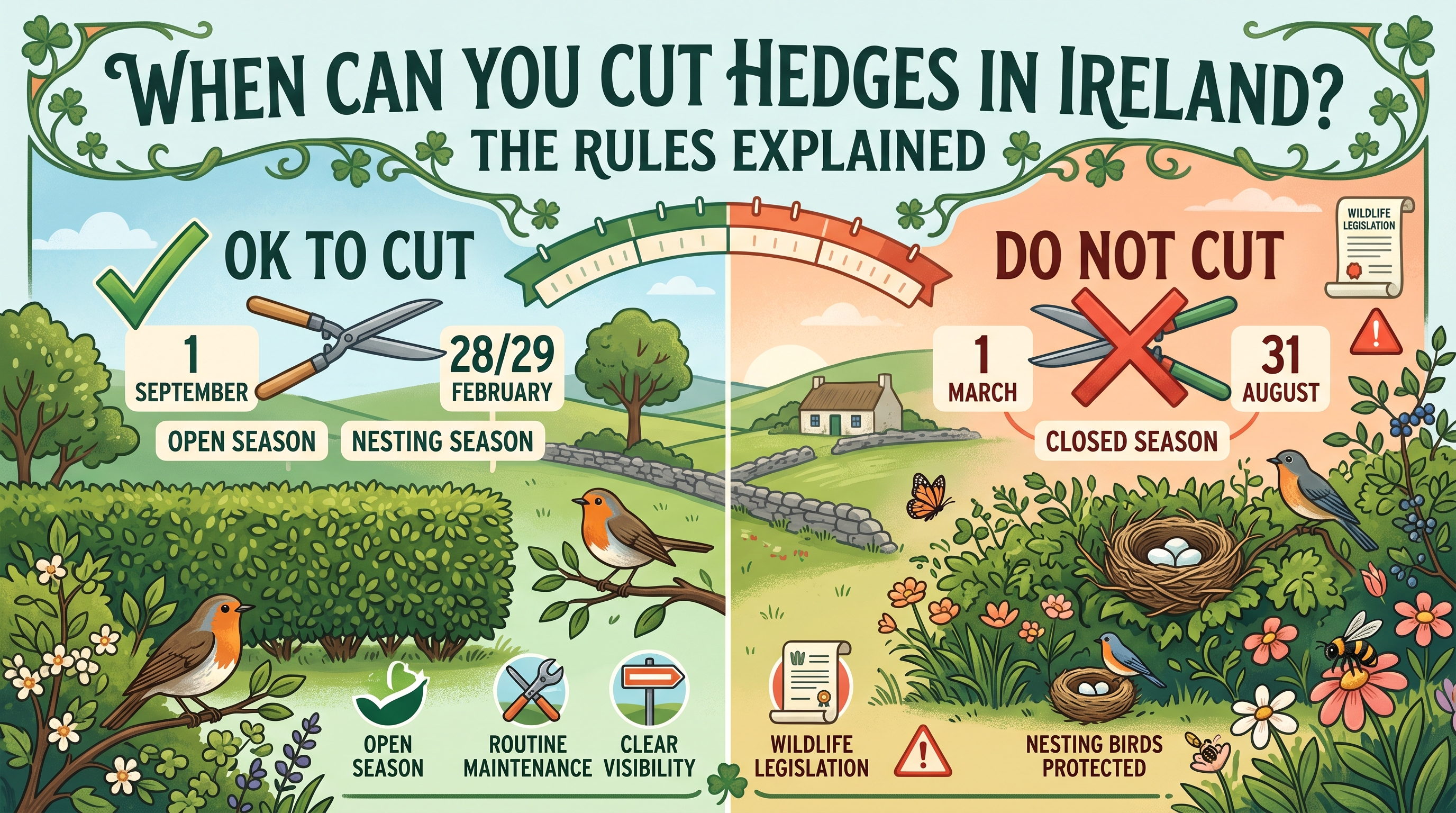
You can cut hedges in Ireland from 1 September to the end of February. From 1 March to 31 August, cutting, grubbing, burning or otherwise destroying vegetation in a hedge is restricted by law, to protect nesting birds.
| Period | Hedge cutting |
|---|---|
| 1 September to end of February | Allowed (check for nests first) |
| 1 March to 31 August | Restricted by law, with only limited exemptions |
What Does the Law Say?
The rule comes from Section 40 of the Wildlife Act 1976 (as amended). It makes it an offence to cut, grub, burn or otherwise destroy vegetation growing in a hedge or ditch between 1 March and 31 August each year. The same section also covers vegetation on uncultivated land during that period.
The point is simple. Spring and summer are when birds build nests, lay eggs and raise their chicks, and hedges are where a lot of them do it. Ireland has little native woodland, so hedgerows are among the most important wildlife habitats we have.
Does the Ban Apply to My Garden Hedge?
Yes, in general. The National Parks and Wildlife Service (NPWS) and BirdWatch Ireland have both made clear that the rules apply in towns and cities as well as the countryside, and that they cover public bodies, contractors and householders alike.
You’ll occasionally see websites claiming that garden hedges are exempt. That isn’t a safe assumption. The exemptions in the Act are specific, and a private garden doesn’t automatically qualify for any of them. If you’re unsure, wait until September. It costs you nothing, and it keeps you on the right side of the law.
Are There Any Exemptions?
There are some, but they’re limited. They include things like:
- Work carried out in the ordinary course of agriculture or forestry
- Cutting a hedge that’s a hazard to road users, under the Roads Act 1993
- Certain road and construction works
The Department of Housing, Local Government and Heritage has said that the exemptions are not a blanket permission, and don’t generally extend the cutting season. For an ordinary garden hedge that’s simply grown too tall, none of these will usually apply.
What Happens if You Cut a Hedge in the Restricted Period?
Illegal hedge cutting is a criminal offence, investigated by the NPWS and An Garda Síochána. Fines of thousands of euro have been issued in recent years, and the people who report it are often neighbours, passers-by and local wildlife groups.
There’s a second rule too. Under Section 22 of the Wildlife Act, it’s an offence to wilfully destroy a wild bird’s nest or eggs, or to disturb a bird on or near a nest, at any time of the year. So even in September, if you find an active nest, stop and leave it alone.
What About Trees and Shrubs?
The law is written about hedges, ditches and uncultivated land, so how it applies to individual garden trees and shrubs is less clear-cut. The nest protections apply to all of them regardless. A sensible approach is to treat trees and shrubs the same way as hedges: avoid big cutting jobs from March to August, and check carefully for nests before any work at other times. Our guide to tree removal and pruning covers this in more detail, including protected trees and bats.
The Best Time to Cut Your Hedge
For most hedges, autumn is the ideal time, from September onwards. The birds have finished nesting, the hedge has stopped its main growth for the year, and berries and seeds that wildlife needs for the winter are already there.
Some tips:
- Fast growers like laurel, privet and leylandii usually need a main cut in autumn, and sometimes a light tidy in late winter, before 1 March.
- Slower hedges like yew, beech and hawthorn often need only one cut a year.
- Hawthorn and other berried hedges are worth cutting later in the season, once birds have had the berries.
- Check before you cut. Look through the hedge for old nests, and stop if you see any signs of birds.
How to Cut a Hedge Properly
- Plan your line. Use string or a straight edge so the top and sides come out even.
- Cut the sides first, slightly wider at the base than the top, so light reaches the lower branches.
- Then do the top, working in steady passes rather than rushing it.
- Don’t cut too hard into old wood on conifers. Laurel, privet, beech and yew will usually regrow from bare wood, but leylandii and other conifers won’t, and you’ll be left with brown patches that stay that way.
- Clear up the clippings so they don’t smother the grass or block the drains.
If the hedge is huge, overgrown or dangerous to reach, it’s worth getting it done by a professional. Tall hedges mean ladders, platforms and a lot of heavy clippings.
What If My Hedge Is Out of Control in Summer?
It happens. A fast-growing hedge can look wild by July, and blocking a path or a window is annoying. A few options:
- Wait until September. For almost every garden hedge, this is the right answer.
- Tidy what’s not in the hedge. Trim back overhanging growth from paths, edge the lawn and clear weeds, none of which involves cutting the hedge itself.
- If it’s a real safety hazard, for example it’s blocking the view at a road junction, speak to your local council before doing anything.
Help Wildlife While You Wait
The cutting ban gives you a nice excuse to let your garden breathe. Leave the hedge to flower, let the berries ripen and enjoy the birds that come to nest in it. Plant a few native species like hawthorn, blackthorn or hazel if you’re thinking of adding to the hedge, and give mowing a rest in parts of the lawn.
Need a Hand With Your Hedge?
Autumn is the busiest time of year for hedge cutting, since everyone is waiting for the same window. If you’d like your hedges trimmed, shaped or reduced this season, get in touch early.
We offer hedge trimming and cutting across Dublin, and can also help with garden clearance, tree work and lawn maintenance, all in the same visit. Send us a few photos for a free quote.
Frequently Asked Questions
When is the hedge cutting season in Ireland?
From 1 September to the end of February. Hedge cutting is restricted from 1 March to 31 August.
Can I cut my hedge in July?
Generally not. The restriction applies to ordinary garden hedges as well as farm hedges, with only limited exemptions that don’t usually apply to homeowners.
Can I do a light trim in summer?
The law refers to cutting vegetation in a hedge, and doesn’t set a minimum amount. The safest approach is to wait until September. Any work that disturbs an active nest is an offence at any time of year.
What’s the fine for cutting a hedge illegally?
It’s a criminal offence, and fines of thousands of euro have been issued in recent years. Prosecution is possible too.
What should I do if I find a nest in my hedge?
Stop work, and leave the area alone until the young birds have left. Destroying or disturbing an active nest is an offence at any time of year.
Can I cut a hedge that’s blocking the road or footpath?
Hedges that are a hazard to road users can be cut under the Roads Act, but if you’re unsure, check with your local council first.
Last updated: 5th October, 2026. This article is a general summary and not legal advice. For official guidance, see the NPWS reminder on hedge cutting and the law and BirdWatch Ireland’s guidance.